
Invest
in
Understanding
Neuropsychological Assessment services for children, adolescents, and adults
Neuropsychological evaluations provide valuable insights that increase understanding of challenges, reduce frustration, and foster self-awareness.
Areas of Expertise
Learning Disabilities
Attention Deficit / Hyperactivity Disorder
Behavioral Functioning
Emotional Disturbance
Yes, Dr. Kane Accepts Insurance
Making psychological assessment services more accessible
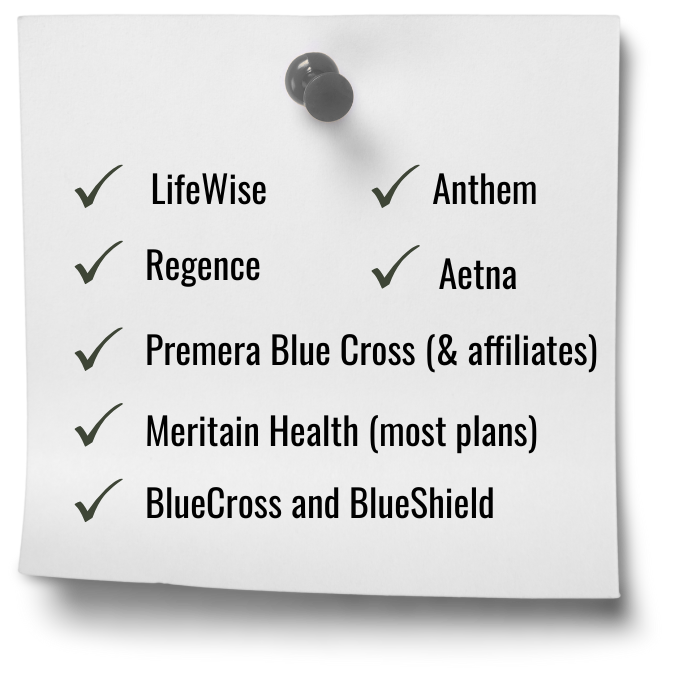
Dr. Kane is currently in-network with the following insurance companies: Aetna, Premera Blue Cross (& affiliates), Meritain Health (most plans), Anthem, BlueCross and BlueShield, LifeWise, and Regence.
Assessment Services
By utilizing norm-referenced, standardized, evidence-based diagnostic measures, Dr. Kane ensures that reliable information regarding an individual's learning style, cognitive skills, and emotional well-being is accurately evaluated. This data-driven approach offers focused help for academic success, career progression, & healthy and informed personal development.
-
Comprehensive Neuropsychological Assessments cover many domains including: neurocognitive functioning, motor speed/dexterity, executive functions, information processing speed, attention, working memory, speech & language, visuospatial skills, visual construction, learning & memory, mood & personality, academic skills, and social cognition.
Who can benefit from a comprehensive neuropsychological assessment?
Children & Adolescents exhibiting executive functioning challenges: Executive Functioning describes a set of cognitive processes and mental skills that help with planning, monitoring, and executing goals. The “executive functions,” as they are commonly referred to include attentional control, working memory, inhibition, and problem-solving. *Common executive functioning challenges are:
Difficulty initiating tasks
Quick to anger and/or aggressive behavior
Late/missing assignments
Low frustration tolerance
Rigid thinking
Impaired memory and/or recall
Challenges with organization
Emotional dysregulation
Poor time management
Children & Adolescents presenting with academic challenges: The Learning Disabilities Association of America (LDA) describes “Learning disabilities” as an umbrella term that covers a range of neurologically based disorders in learning and present in individuals with various degrees of severity. Broadly speaking these disorders involve difficulty in one or more (but not uniformly) psychological processes: (1) input (auditory and visual perception), (2) integration (sequencing, abstraction, and organization), (3) memory (working, short term, and long-term memory), (4) output (expressive language), and (5) motor (fine and gross motor). Learning disabilities vary from individual to individual and may present in a variety of ways. *Common signs of learning disabilities are:
Task avoidance
Procrastinate starting or completing assignments
Capable but not “performing” academically
School refusal
Missing and/or incomplete assignments
Physical symptoms (headaches, stomach aches)
Poor handwriting
Emotional dysregulation (i.e., increased irritability)
Difficulty following instructions
Disengaged in school or loss of interest in participating
Increasing frustration
Children & Adolescents experiencing emotional vulnerabilities and behavioral concerns: Concerns relating to anxious features, depressive features, phobias, fears, mood dysregulation, mood fluctuations, aggressive behaviors, self-harming, self-isolating and/or behaviors presenting as compulsions or obsessions. *Some children and adolescents may present with the following:
Difficulty concentrating
Physical symptoms (headaches, stomach aches)
Emotional dysregulation (irritable, pessimistic)
Prone to outbursts
Difficulty with sleeping
Challenges adapting to changes
Impulsive behaviors
Increase/decrease in appetite
Increase/decrease in interests
Sleep difficulties
GOAL of a Comprehensive Neuropsychological Assessment is to:
Clarify diagnoses: a comprehensive assessment can differentiate between conditions with overlapping symptoms, such as AD/HD, and learning disabilities and/or AD/HD and anxiety by providing a detailed profile of a child's cognitive and academic strengths and weaknesses.
Inform educational planning: The comprehensive assessment provides a basis for obtaining school interventions and/or supports, such as an Individualized Education Program (IEP) and/or accommodations as outlined in a Section 504 Accommodation plan. Dr. Kane can offer specific and actionable recommendations for teachers and parents.
Drive treatment recommendations and interventions: Provide individualized recommendations and interventions concerning academic support, mental health treatment, and/or behavioral supports.
*Examples of symptoms or behaviors provided above are not exhaustive nor intended for any diagnostic purpose. If you are in crisis or require immediate support, help is waiting. Statewide crisis line, dial 211; Washington State Crisis Connection dial, 866.427.4747. Additional support options are listed on the resource page.
-
Structured and objective process used to evaluate an individual's cognitive, emotional, and behavioral functioning without an educational testing component. This testing is appropriate primarily for adolescents who have an established academic history and there are no concerns regarding academic performance and/or learning.
Who can benefit from a psychological test? *Adolescents with a family history relating to neurological disorders, emotional vulnerabilities, or behavioral challenges and adolescents experiencing:
Attention/concentration challenges (easily distracted, “hyperfocus,” etc.)
Executive functioning deficits (i.e., organization, task initiation, forgetfulness, time management, missed deadlines, etc.)
Challenges adapting to change and/or rigid thinking
Impulsive behaviors (interrupting others, struggling to consider the impact of behavior, thrill seeking, etc.)
Emotional vulnerabilities (excessive worry, panic attacks, isolating, withdrawing from activities, etc.)
Behavioral concerns (self-harming behaviors, aggressiveness, verbal/physical outbursts, compulsions, obsessions, etc.)
*Examples of symptoms or behaviors provided above are not exhaustive nor intended for any diagnostic purpose. If you are in crisis or require immediate support, help is waiting. Statewide crisis line, dial 211; Washington State Crisis Connection dial, 866.427.4747. Additional support options are listed on the resource page.
-
Psychological testing for adults includes: Cognitive Testing: To determine a person’s strengths and weaknesses and assessment of attention, verbal comprehension, visual-spatial ability, computation, abstract thought, impulsivity, problem solving, social comprehension, and judgment. Emotional/Personality Profile: To assess for depression, anxiety, obsessive/compulsive disorders, etc. Executive Functioning: To evaluate self-regulation, problem solving, planning, organization, inhibition, self-awareness, and working memory.
Adults seeking psychological testing can benefit from the identification of cognitive strengths and weaknesses to predict the ability to perform daily living activities and identify subtle cognitive deficits. In addition, individualized recommendations are provided, allowing for future informed decision making.
-
Cognitive assessment, also referred to as an IQ Test, is designed to evaluate a person’s capacity for abstract thought, problem-solving, and reasoning.
Who can benefit from an Intelligence Assessment? If you are seeking to better understand your own cognitive profile to inform personal growth.
-
Removing the guesswork from academic challenges. Educational testing as a part of a comprehensive neuropsychological assessment. Educational testing provides a comprehensive understanding of a students cognitive and academic strengths and weaknesses. This type of testing is particularly beneficial for a number of different groups, including:
Students with Learning Difficulties: Educational testing can help identify the underlying neurocognitive factors contributing to struggles in school. It goes beyond simply identifying a learning disability by explaining why a student is having trouble with reading, writing, or math. This deeper insight can lead to a more accurate diagnosis and effective, targeted interventions.
Students with Known or Suspected Diagnoses: For students with conditions like AD/HD, Autism Spectrum Disorder, or other developmental delays, educational testing can clarify how these diagnoses impact their learning and functioning in a school setting.
Those Needing Accommodations: The results of the assessment can provide helpful documentation to qualify for special education services, accommodations (like extended time on tests), or a 504 Plan, or Individualized Education Program (IEP) in school.
Students and Families: The evaluation provides a clear roadmap for parents and educators, outlining how a child learns best and what specific strategies and interventions will be most effective. It empowers parents to be stronger advocates for their child's education and well-being.
Progress Monitoring: For students with established learning disabilities, educational testing as a part of a neuropsychological re-assessment provides essential data ensuring interventions continue to be effective.
-
Structured cognitive assessment utilizing norm-based measures to determine exceptional intellectual abilities.
Who can benefit from a gifted assessment? Individuals seeking to better understand their own cognitive functioning or their child’s functioning. These assessments are often required for admission consideration to select academic institutions.
-
Twice Exceptional (2e) refers to individuals who are both intellectually gifted and have a learning disability or other neurodevelopmental condition. A formal holistic assessment, including cognitive evaluation, educational testing, and neurological measures identify discrepancies between cognitive abilities or asynchronous development.
Who can benefit from a twice exceptional assessment? The Misunderstood Child: A 2e assessment is critical for children whose giftedness and disability mask each other. A gifted student may use their intelligence to compensate for their disability, performing at or near grade level and therefore not qualifying for special education services. Conversely, a student with a disability may have their giftedness overlooked because their struggles make them appear to be "underachievers" or simply "not trying hard enough." Parents and Caregivers: A 2e assessment provides a clear, documented explanation for the child's asynchronous development—the significant gap between their intellectual abilities and their academic or social-emotional performance. This helps parents understand their child's unique profile and become more effective advocates for them in school. Students Themselves: For the individual, an assessment can provide a profound sense of self-understanding. It can help them realize that their struggles are not due to laziness or a lack of intelligence, which can be a major boost to their self-esteem and confidence.
A twice exceptional assessment benefits anyone who is struggling to understand a complex and seemingly contradictory learning profile. By accurately identifying both strengths and weaknesses, it unlocks the potential for personalized support, improved self-esteem, and greater success in academic, professional, and personal pursuits.
How to Get Started

Contact
Use the connect button below to complete a secure inquiry.

Support
Have questions? Not sure what to ask your insurance company? Looking for detailed information about assessments? Let’s work together!

Intake
Ready to schedule? Utilize the digital HIPAA-compliant client portal for intake document management.
Dr. Samuel Kane
Are you, your teen, or your child facing learning, behavioral, or emotional hurdles? As a clinical neuropsychologist, I employ an evidence-based approach to evaluate potential learning challenges, attentional deficits, emotional vulnerabilities, or behavioral difficulties serving children (6 years and older), adolescents, and adults.
A comprehensive neuropsychological assessment helps identify strengths and areas that require support, leading to a personalized plan for success. I would be delighted to be a part of your journey to understanding.